
Rethinking EdTech: Learning that works where the internet doesn’t
Today, around 2.2 billion people are still completely offline – a figure confirmed by the International Telecommunication Union (ITU, 2025). That’s roughly a quarter of the world’s population. Most of them live in low‑ and lower‑middle‑income countries, often in rural areas where connectivity remains scarce or unaffordable.
But the digital divide doesn’t end there. Hundreds of millions more technically do have access to internet, yet struggle with connections so slow, unstable, or expensive that following an online course or watching a youtube tutorial isn’t possible in practice.
“Now I can work at home and at my own pace”

Baby Thomas
This is the reality that shapes the daily life of Baby Thomas, a 40‑year‑old farmer from Sierra Leone. On her two‑acre plot in Moyamba, a small village in the Eastern Province, she tends rows of cocoa trees that thrive in the region’s dense, humid groves. The landscape is rich, but the digital infrastructure is not.
Mobile reception is intermittent, data is expensive, and for long stretches of the day, the internet simply doesn’t exist. Like many farmers in the area, she had never received formal agricultural training – relying instead on neighbours, observation, and whatever advice happened to reach her.
That changed in 2026, when she joined the Dynamic Agroforestry (DAF) project. The initiative, implemented by Tradin Organic, Ecotop, local farmer cooperatives and SkillEd, aims to reduce deforestation, enhance biodiversity and build a more sustainable cocoa value chain.
“I installed the SkillEd app and the training package on my phone. Because the training works fully offline, now I can learn at home and at my own pace”, Baby Thomas explains. Today, she serves as a lead farmer, guiding a group of ten men and women in her community. She says the offline modules help her understand new practices more clearly and apply them directly on her farm.
“When I learn something, I can try it the same day. It gives me hope. I want my children to use the app when they are older.”
Why learning systems must work without connectivity
Baby Thomas’ experience reflects a much wider reality. In many parts of the world, going to school or university is not a straightforward option – not because people lack motivation, but because schools are too far away, conflict makes travel unsafe, teachers are scarce, school fees are high or families cannot afford to lose a working pair of hands for a full day.
In these situations, digital learning becomes the only realistic alternative. Yet even that pathway often closes the moment a learning system depends on stable internet. For millions of schoolchildren, midwives, entrepreneurs, refugees and adult learners, the network simply isn’t there when they need it – or it works so poorly that videos won’t load, pages won’t open and lessons stop mid‑sentence.
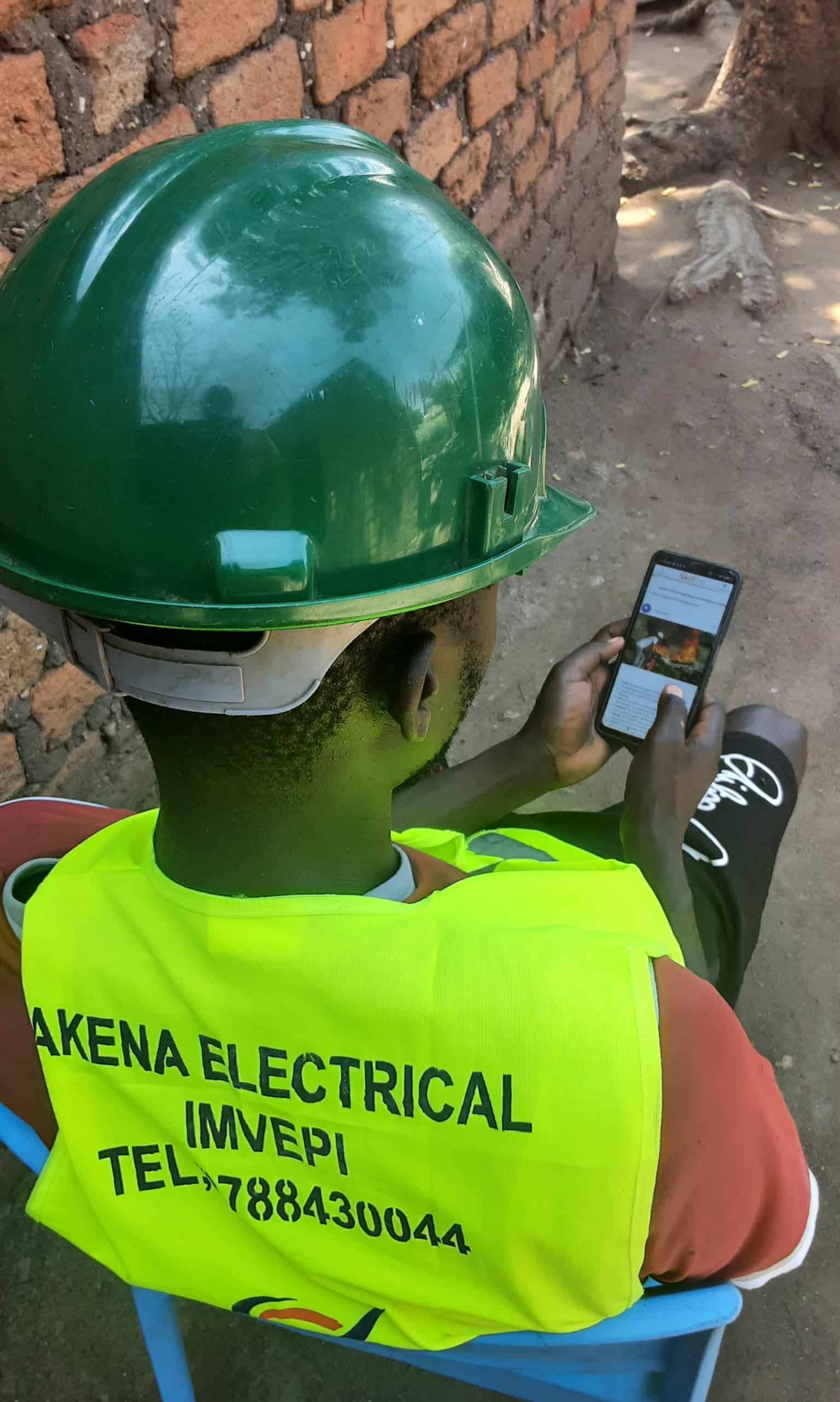
Digital training in the Circular Refugee Camp Imvepi
This often raises a practical question: how can people in remote or low‑income areas use digital learning at all? But in reality, smartphones are far more widespread than many assume. Many families own older or second‑hand devices – often the same models that people in wealthier countries replace every two or three years. Others receive their phones through NGOs, community programs or local savings groups.
Charging is rarely a barrier: in many regions, people use small solar panels, neighbourhood charging kiosks, market stalls or shared power banks. Even in off‑grid villages, a phone can usually be charged for a small fee.
For learning, a basic smartphone is often far more practical than printed materials. Books are expensive to produce, heavy to transport and difficult to keep in good condition. In humid climates, they mold quickly; in tropical regions, insects eat the paper; in conflict zones or refugee camps, they are easily lost or damaged. And once printed, they cannot be updated – meaning learners often work with outdated information.
A smartphone, by contrast, can hold hundreds of lessons, videos and assessments in a single device. It can be used anywhere, for instance in the field by farmers, while following the practical instructions on new farming practices. Once the content is loaded offline, it can be shared from phone to phone and used for years without needing a signal or a data plan. But for this to work, the learning system itself has to be built differently.
A lightweight architecture for heavy‑duty challenges
“We designed the SkillEd learning system to function fully offline – even in places without power,” says Erik van Elderen, SkillEd’s CTO and co‑founder. The platform is designed specifically for places where connectivity is unreliable, unsafe or simply unavailable.
Most digital learning systems – even those that offer some form of offline mode – still depend on a central database. Courses are stored in many separate pieces, and a learner must be online at least once to download all the components. In regions where the nearest reliable connection is hours away, too expensive to use, or restricted for security reasons, that model breaks down completely.
SkillEd takes a different approach. “We package each course as one compact JSON bundle,” Erik explains. “Learners can share that bundle as a single zip file from phone to phone – via Bluetooth, SD card or whatever method they have. The app reads everything locally, without ever needing a server.” This makes it possible for learning to spread through a community even when no one has internet access at all.
The same principle also works for groups. Instead of relying on a cloud server, SkillEd content can be hosted on a tiny mini‑computer – sometimes no bigger than a flash drive – that acts as a local web server for a classroom or training group. No internet is required, and sharing files or applications becomes far faster than passing around SD cards or connecting phones one by one.
Teachers can also access an offline admin area, where students submit assignments directly to the local device. Everything stays within the small network, and the entire setup can run on a simple battery charged by a solar panel. It’s a way of delivering full digital functionality in places where electricity and connectivity cannot be taken for granted.
Making a difference
This approach has since become a cornerstone of SkillEd’s projects worldwide. Across Africa, SkillEd, together with various partner organisations, supports offline digital learning in Nigeria, Uganda, South Sudan, Ethiopia, Tanzania, Mozambique and Kenya. Through the Blue Deal partnership, the on/offline Android app is used in Mozambique, Ethiopia and Burkina Faso, with new programs starting soon in Peru.
In Egypt, the BUCRA project (funded by the Dutch Enterprise Agency (RVO)) will soon have an on/offline training app available with training modules on climate-smart agriculture for small-scale farmers. Earlier projects in Ghana, Benin, Mali and Mozambique have shown the same pattern: offline learning is essential for reaching learners consistently. And in Afghanistan, SkillEd is used in underground schools for girls – places where the internet may technically exist, but connecting to it can put lives at risk.

The on/offline VeggieTap helps farmers in Myanmar and many other places improve their harvest (photo by EWS-KT)
In Myanmar, where civil‑war disruptions make online access unpredictable or dangerous, farmers and home gardeners have access to lessons about advanced vegetable production techniques via the free VeggieTap.
The app was developed by SkillEd and East-West Seed Knowledge Transfer (EWS-KT) and provides offline capabilities, local languages and a completion certificate. The same app – adapted to the local conditions and language – is available in the Philippines, where many farmers live completely off-grid in the rain forest area. “In the Philippines, we use Raspberry Pi’s as local servers. A single Pi can store hundreds of courses and serve them to many phones at once, enabling dashboards, exams and teacher statistics without touching the internet. It’s tiny, fits in a pocket and runs on a simple battery or a small solar panel,” says Erik van Elderen.
The global conversation about EdTech often focuses on devices, platforms and bandwidth. But for many learners, the real breakthrough comes from something far simpler: the ability to learn whenever they have the time, wherever they happen to be, without waiting for the internet to cooperate. As long as connectivity remains uneven, offline‑first learning will continue to open doors for people who would otherwise be left out – from home gardeners in the Philippines to female entrepreneurs in Ethiopia, from cocoa farmers in Sierra Leone to schoolgirls in Afghanistan.